The Syai Ultra CGM Review
The Syai Ultra review looks at some of the key features and benefits of the Syai Ultra CGM including easy application, innovative AI, assisted logging and vast amounts of data.
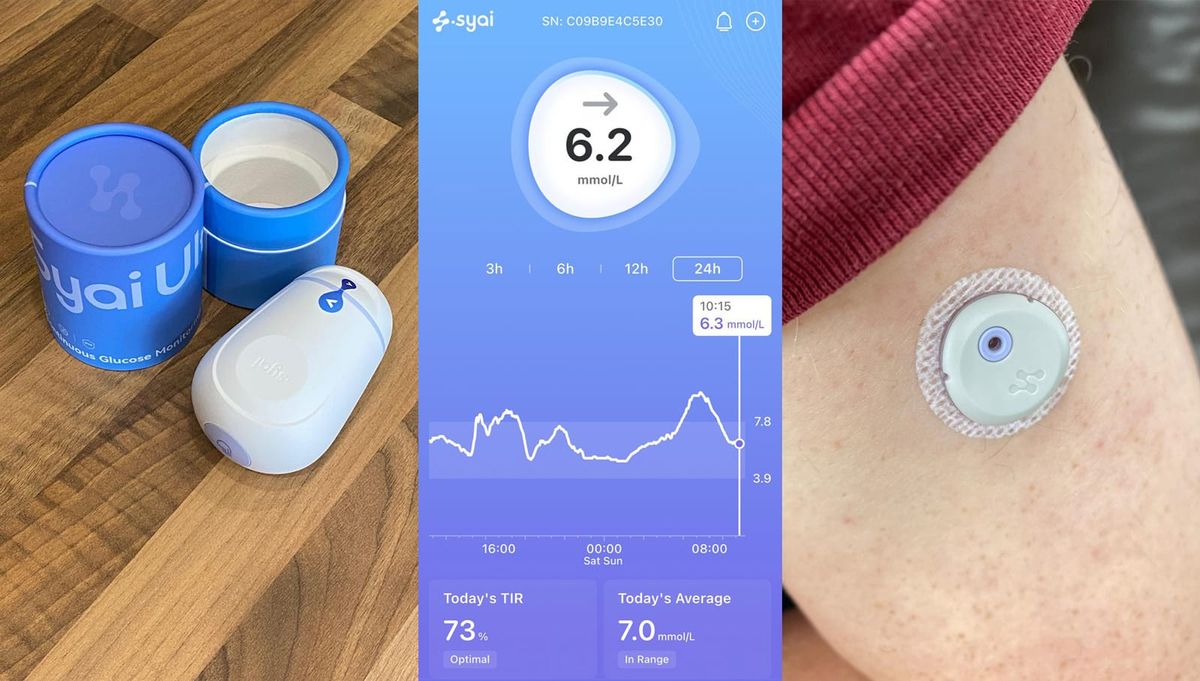
Part-way through my Big CGM Review, I was contacted by Spencer Martin at Glucose Evolution and he sent me a Syai Ultra continuous glucose monitor (CGM) sensor to try out. He's been working with CGMs for decades so knows his stuff. I hadn't heard of this CGM before I started my review as it didn't come up in my research on self-funded CGMs. I have been using this for over two weeks now and have outlined the features I found most useful below.
Upfront cost: £45 single sensor / £87.30 two sensors
(Save 10% with my discount code below)
Delivery cost and time: £3.55 Royal Mail Tracked 48 or free for two-sensor pack.
Duration: 14 days
Effective daily cost: £3.12 (or £2.81 with discount code*)
Effective annual cost: £1,138.80 (or £1,024.92 with discount code*)
MARD: 8.1%
Application
The applicator has a single button to click when you're ready to apply the sensor. Along with the Dexcom sensors, this feels like the easiest option. The Libre 2 comes as a separate sensor and applicator which can make it easy to mess up the application and ruin a sensor if you're not confident in the process. The Yuwell CT-3 has a separate transmitter which can be recharged, so is good for reusability, but can be a bit fiddly the first time you apply it. The only mistake I made with my first application of the Syai Ultra was forgetting to use the alcohol wipe before opening the applicator which is my own stupid fault 😖.
Accuracy
The Syai Ultra wasn't included in the same stress tests that I did on the Dexcom, Libre and Yuwell CGMs so it's not fair for me to make definitive conclusions on accuracy differences, but after a dozen glucose meter comparisons, it seems to have similar accuracy to the Yuwell CT-3 which I found to be the most accurate one from my basic glucose meter comparisons.
App features
Logging
The Syai app has a flexible approach to logging. You can choose whether to manually type in details or you can use AI options to log via an image or voice recognition.
The 'Smart Food Log' scanner automatically logs meal items using AI image analysis of a photo taken with your phone. It does a good job of this and I've found it is slightly more accurate at guessing the ingredients correctly than my usual MyNetDiary app that I use for detailed macro logging. The only thing I think is missing is the option to use an image you've already taken from your photo library and although it does keep the image in the app's log, it doesn't save the image to your phone (I'm one of those people who photographs everything they eat 😅).
The 'Voice Log' feature also works very well. I just have to remember to talk s-l-o-w-l-y so it doesn't fall over my Bolton accent. This also works well for exercise logging and it automatically categorises food and exercise events correctly. Saying "Please log a 30 minute walk." can be a lot easier than tapping away as you're setting off (you can adjust the time taken later).
You can also log your weight which will automatically calculate your BMI figure.
Syai AI
Syai have taken an innovative step in including an AI chat feature within the CGM app itself. I've spent many hours (probably days) of my life arguing nutritional and metabolic topics with ChatGPT. Syai AI includes this for free as part of the CGM app. It's important to be aware that these AI language models don't always give you the most accurate or nuanced biological or medical information so I wouldn't rely on it without consulting a medical professional or doing my own fact-checking through trusted websites or books, but it's good for technical overviews and recipe suggestions. I've found that Syai AI is quite saturated-fat-o-phobic - it's convinced that Ancel Keys' diet-heart hypothesis (eating saturated fat clogs your arteries) is true and no amount of arguing with it seems to get it to understand that you want it to reject this idea. I have found that ChatGPT is more able to adapt to using your point of view (with a suitable amount of nagging). Syai AI also lacks the option to attach an image which would be good for meal feedback.
Reporting
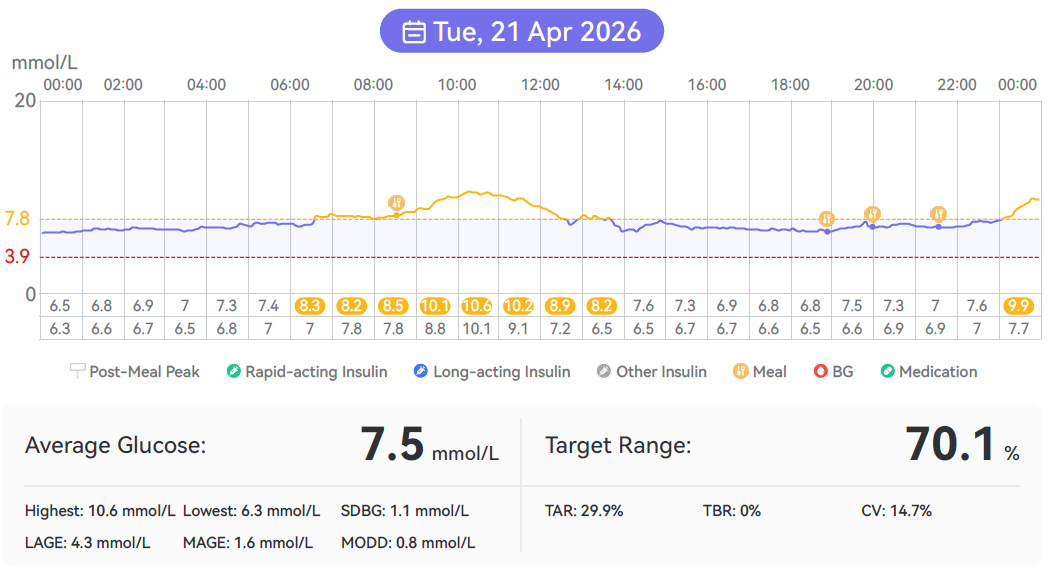
Personally, the stand-out feature on the Syai CGM is its ability to automatically log the resulting glucose peak after a meal or drink. This is something that I've had to guess on the Libre sensors by trying to visually guess where the top of a peak lines up with the y-axis. With the Dexcom and Yuwell apps, finding the peak is a bit easier because you can select the peak point on the graph to see the actual value, but it is fiddly and difficult to re-visit the data after a day or so. With the Syai app, you can scroll through daily entries in the 'Logbook' to pick out the dietary insights on any food or drink item that you've logged. So far I haven't hit a limit on how far you can go back to review entries.
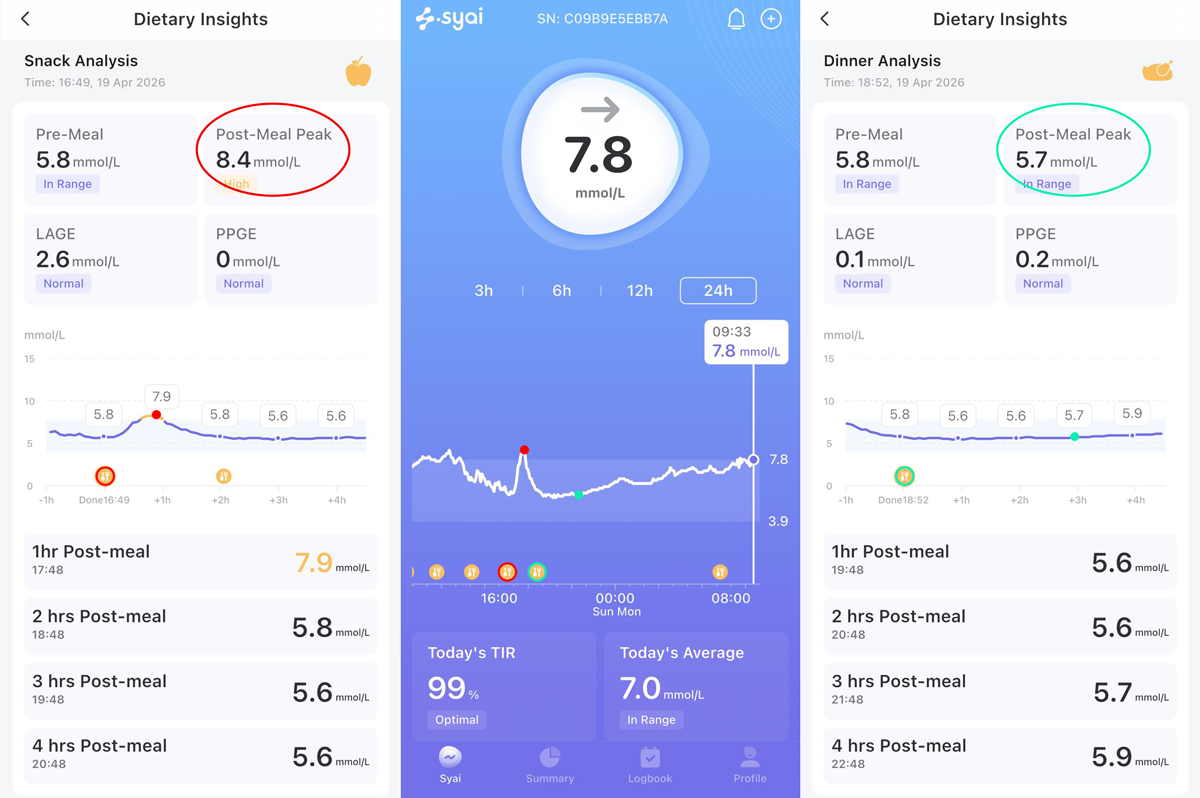
The LAGE figure above is 'Largest Amplitude of Glycemic Excursion' - which in normal language is 'how big your glucose peak was after eating something'. This is a helpful number to look at because you can use it to evaluate your glucose response to different food and drink using a basic scoring system (e.g. for my own personal targets, I roughly view 0-1 = good, 1-2 = okay, 2+ = bad, 4+ = very bad). If you want the simplicity of using just one data point for checking your glucose response to meals, I'd choose this one.
Summary Reports
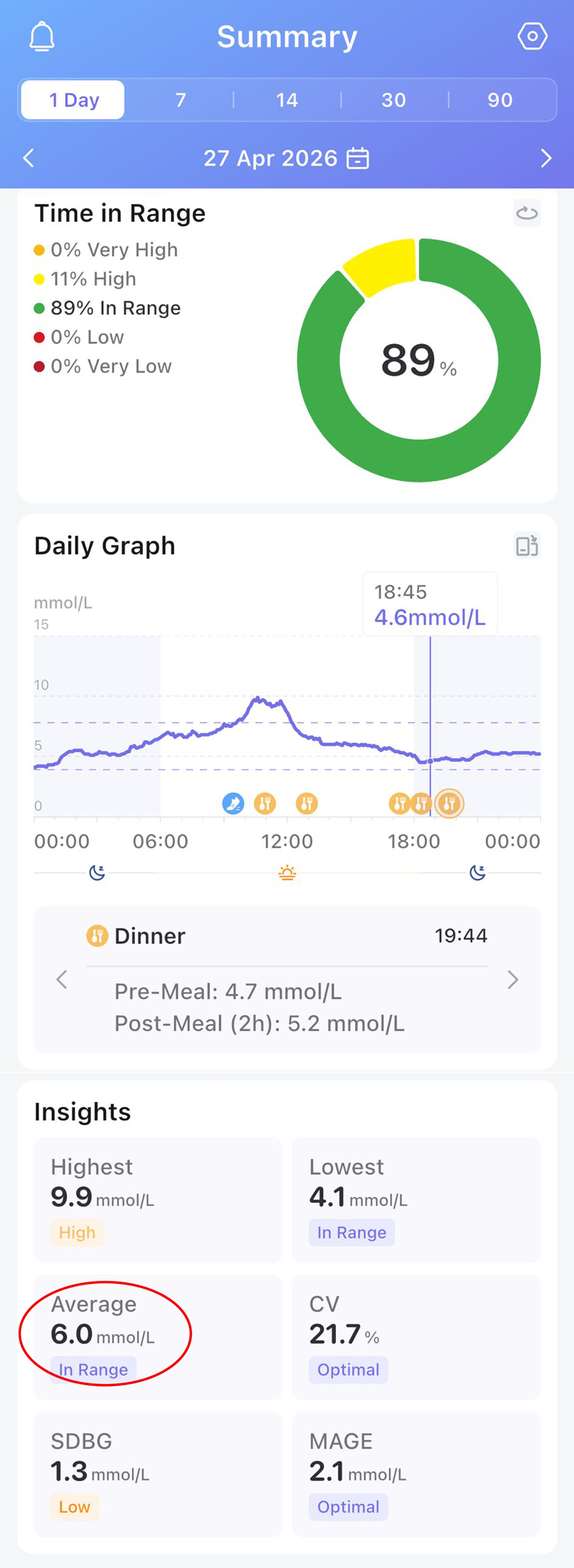
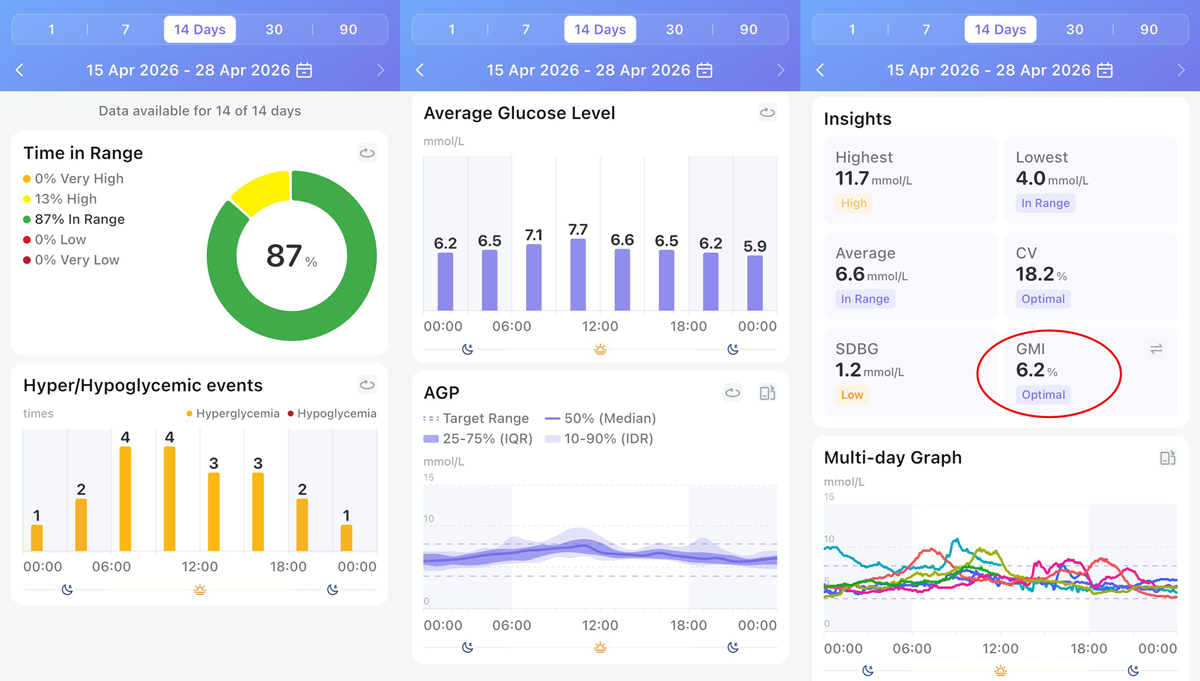
The 'Summary' report section gives you longer-term patterns of how your glucose control is going. The Syai app gives a much broader range of technical information than other CGMs that I've tried. Data points such as CV, SDBG, MAGE indicate glucose variability and are great for data nerds like me but the key things to look at are 'Time in Range' and 'Average'. You can set your personal target range within the Syai app settings. I've always found the lack of the daily average being available directly in the Libre 2 app quite frustrating so having this available for individual days is a big plus for the Syai Ultra.
The 'Daily Graph' gives you the option to cycle through points via logged events. You can also tap points on the graph to find peak and trough values.
Changing to 7 or more days on the 'Summary' report adds in the AGP (Ambulatory Glucose Profile) graph which is similar to 'Daily Patterns' on the Libre app, which I find very useful. The median line is effectively your baseline, and IQR (interquartile) and IDR (interdecile) ranges show levels of variation. The general goal for type 2 diabetes is to keep your baseline low and the IQR and IDR bands as narrow as practically possible.
Looking at 14 days or more will show your GMI (Glucose Management Index) which is the CGM's estimate of your next HbA1c blood test based on the readings it has available.
Glucose Reports
Once your CGM expires, after 14 days of use, the Syai app will provide a 'Glucose Report' which you can view in the app or export as a PDF document. This would make it easy to print out and take with you to a diabetic review appointment. The report shows the same data as the 'Summary' report but also includes some additional details which are helpful.
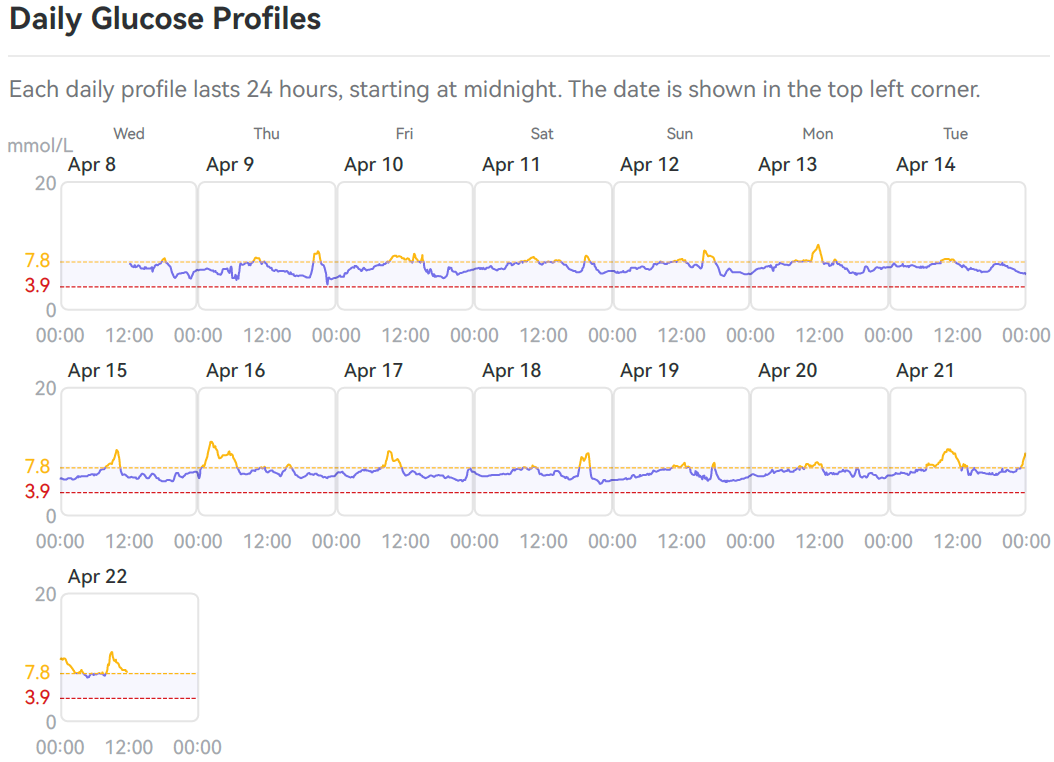
The 'Daily Glucose Profiles' shows you your daily graphs lined up next to each other so you can see the full two week pattern of whether your glucose is going up, down, or staying consistent.
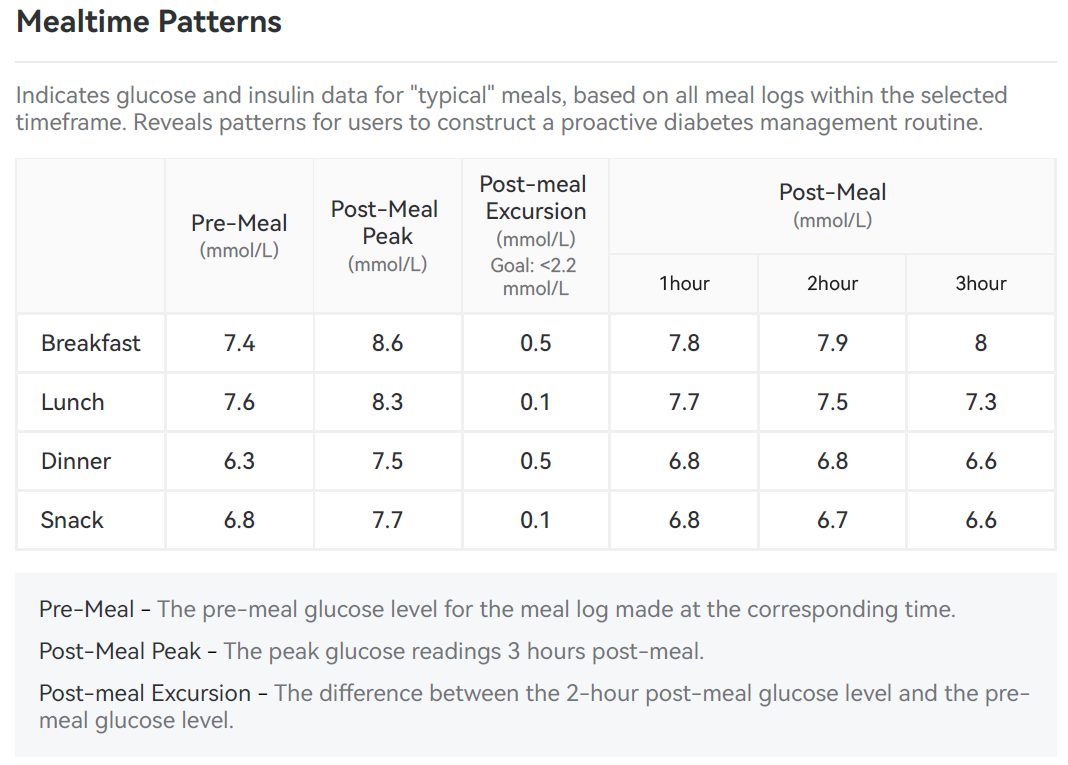
'Mealtime Patterns' shows trends around mealtimes which can be helpful in spotting problems with regular meal choices.
At the end of the report there is a 'Daily Log' of each day's detailed glucose graph which could help you spot a bad management day and look into what caused a problem.
Conclusions
The Syai Ultra has some impressive additional features that other CGMs don't have, such as AI integration, much more detailed statistics, and easier logging options where you can use either voice or image recognition. Logging food and exercise can be a real hassle, especially when out in public, so this is a big help. It's also so tiny that I've found myself forgetting it's there. Personally, the lower cost and extra data points mean it has taken over from the Libre 2 as my regular CGM.
Ordering a Syai Ultra CGM
You can get 10% off your Syai Ultra sensors by applying my War on Diabetes discount code, WOD10 at checkout. If you want to order two or more sensors, make sure to select the two-sensor product option as this works out cheaper.
Sponsored*
Bitter melon & cinnamon tea

I'm back to trying one-day fast per week and herbal (or at least no dairy) teas help to relieve hunger niggles without breaking a water fast. A friend on the PHC course recommended bitter melon for help with glucose control so I decided to try this Nutra Glycemia tea and it's my new favourite for when I can't be bothered with the preparation steps for my BDNF-boosting tea with its multiple ingredients. The cinnamon and fenugreek form a well balanced sweet and earthiness. This one is now part of my daily routine whether I'm having a fasting day or not.
Shirataki noodles
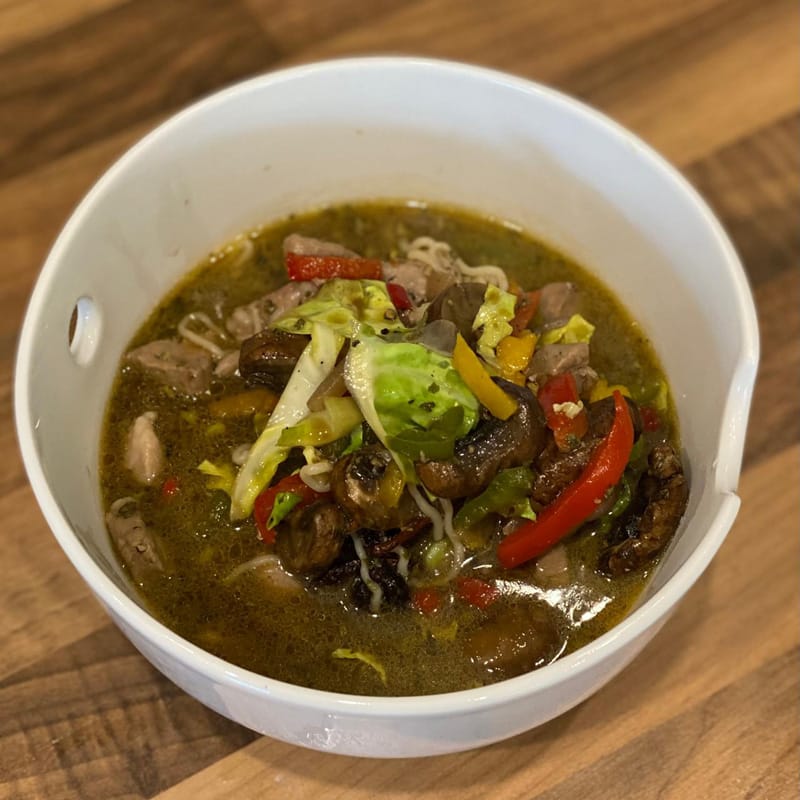
Shirataki noodles (not to be confused with shitake mushrooms) are super-low-carb noodles. They are made from konjac root (no, not the brandy - it's Southeast Asian elephant yam root). I add them to my regular pork ramen and they work well with a chicken curry as well.